Acres of Fuel, Days of Work
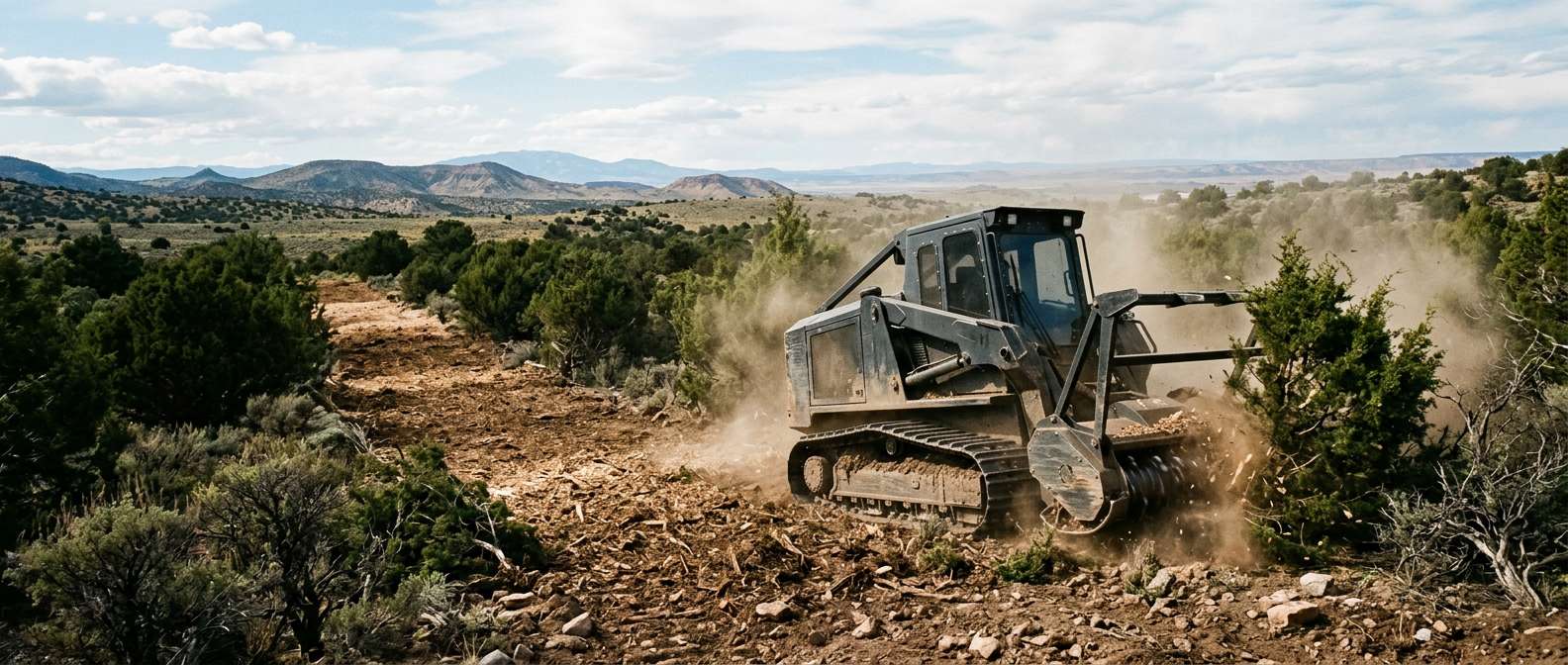
Mastication is how large-lot fire mitigation gets done at a survivable price. A drum masticator on a tracked carrier grinds standing juniper, brush and small-diameter pine into chips in minutes per clump — work that would take a hand crew weeks — and leaves the material as an even mulch layer on the ground. Nothing is piled, burned or hauled, which matters doubly in a county with no free disposal program and long stretches of every year under burn restrictions.
Why the Mulch Layer Is the Point
Standing brush is vertical fuel with air through it — built to burn. The same biomass ground flat becomes a dense, moisture-holding blanket that shades out regrowth and decomposes into the soil. On piñon-juniper ground the win is durable: junipers don't resprout from the stump, so a masticated lot stays open for years, with grass — a mowing job — as the comeback fuel instead of resinous canopy.
What Mastication Handles — and What It Doesn't
A forestry mulching drum eats standing brush, juniper of any thickness, and pine up to roughly 6–8 inches of diameter, on ground a tracked carrier can hold. It does not fell mature timber — big ponderosa comes down by chainsaw first, and the masticator cleans up the tops. It does not grind stumps flush (that's a stump grinder), and it stays out of the 5-foot Zone 0 ring where even mulch shouldn't accumulate. On steep foothills pitches, hand crews finish what the machine can see but can't reach.
That is why real fire mitigation quotes usually pair the two: machine passes for the acreage at per-acre rates, hand crew hours for the close-in and steep work. One written estimate, one mobilization, one finished property.
Who Books Mastication in Pueblo County
- Pueblo West owners with full acres of piñon-juniper — converting continuous canopy into spaced islands, and clearing vacant lots the abatement program can cite the same as built ones.
- Foothills acreage owners in the Beulah, Rye and Colorado City country thinning heavy fuels after a season that showed exactly what continuous fuel costs.
- Buyers and sellers clearing before listing or after closing — insurers increasingly inspect WUI properties at policy issue, and cleared ground photographs well.
- Neighbors splitting a machine day. Mobilization is a real cost; adjacent lots booked together bring the per-acre price down for everyone.
Call (719) 415-3216 with your acreage and terrain — a licensed crew will walk it and quote machine work, hand work and the maintenance plan as one written price.